

A Second Love
A Love that Fell Between the Social Clock and the Heart

My recent breakup has made me think a lot about love; not the kind of love that lasts, but the kind that doesn’t. My second love did not last. We loved one another, made promises ocean deep (as Taylor Swift says), but ultimately went our separate paths.
Breaking up while still in love with someone feels like a natural disaster. It destroys your home and leaves you with only the land it once stood on. Within an instant, everything’s gone, changed, yet internally, your yearning for home persists.
In one of my developmental psychology classes, I learned about the social clock—an invisible bucket list of milestones society pressures us to check off to fit in: go to college → become financially stable → get married → have kids. When you're a senior in college, the clock tells you to chase independence, ambition, and your future self. So what happens when love tries to exist within that framework? Or as one of my favorite art pieces alludes to: Can love escape time’s inevitable triumph?
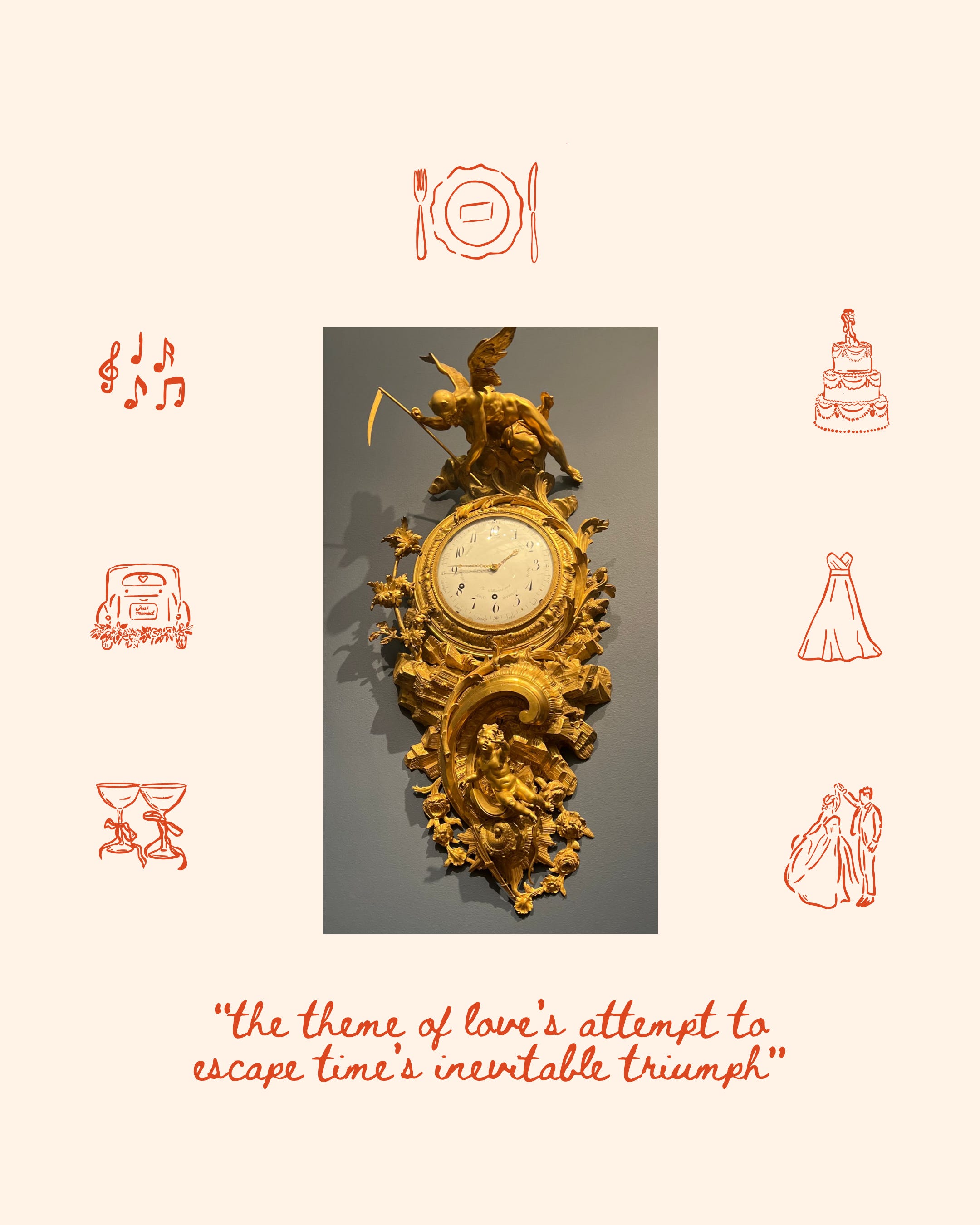
So with this, I’ll share my recent handwritten entry on my second love, James. For the purpose of this Sub, I will refer to my ex under the alias of James: one, to protect his identity, and two, to remind myself that he has to become a somebody I used to know. Okay, now back to the story.
James and I broke up about a month ago. Toward the end of our relationship, I felt deeply safe and content—a feeling I’d never experienced in a romantic context before. Despite this depth, I know I had only read the first chapters of the novel of love we were capable of.
James and I started dating as seniors in college, both aware of the heartbreak we were signing ourselves up for. Yet, naturally, as 22-year-olds, we jumped into love rather than walking the more logical path of "what if." When we first started talking, I was applying to clinical psychology PhD programs across the country. Throughout this process, I was uncertain of where I’d be living the next year, what I would be doing, or if I’d be happy. My mind was constantly in the future. I was self-aware of this, but couldn’t stop myself from the feelings and thought spirals associated with the last chapter of college. When I looked at my present, I was certain I wanted James in it; he was the one bit of clarity amongst all the unknowns.
We started dating in November. Terrified, happy, excited. Shocked I could feel this way about someone again. The six months that followed consisted of picnics, walks, birdwatching, concerts, breakfast on Sundays, music, and passion-sharing. Our roots kept growing while time kept ticking, anticipating the transplant shock that was to come.
It was never a conversation of if we would break up, but when. James never wanted a long-term commitment. I truly don’t think he would allow himself to entertain the thought: Could we exist outside of Fort Worth? How would we grow together? Where would our shared path lead? I guess if you never conceptualize a future in love, you can’t desire it; and, as they say, desire is the root of suffering. I, however, had conceptualized a future with us many times. Now I’m learning how to stop suffering.
Our breakup was the logical thing to do. We both had new diplomas in hand and the world at our fingertips. Everyone around me told me: Choose yourself. Choose your career. Commit to your future. No one said to choose James, and in many ways, I think this is sound advice. Don’t get me wrong—I am excited for my career. I am excited for research, for writing, for designing. But I was also excited about love—about how I felt in this partnership, about the kind of person that love was shaping me into. The love I had for James felt as strong as my feelings for these professional parts of my life, so why should I subscribe to the assumption that it was most logical to not even consider chasing it?
Sharmeen Jariullah, my Women and Gender Studies professor, once asked why moving for a career is socially reinforced; why are we encouraged to make big, life-altering decisions for professional advancement, but not for a relationship? Perhaps it’s because a career is more stable. Less likely to leave you high and dry. But as I’m processing all of these feelings, I can’t help but wonder if, in a couple of decades, I’ll look back and realize how unique this love was. How rare is it to find someone that you can grow with? What happens if you cannot find someone willing to commit to not just falling in love, but growing in love? I don’t know the answers to any of these questions, but I do know I will continue to wonder about another reality where my heart set the time.
Thank you so much for reading the Handwritten.
Here, I seek to reclaim a small corner of the internet as a brave space for honest conversations, where we can all heal.
Subscribe to follow along with my Lessons in Love series. I Loved You and I Meant It is a sequel to this piece, A Second Love, both sharing the story of my last relationship.1 The next essays in Lessons in Love will explore what love means to me: how I want to give it, how I wish to receive it, who I want to be as a partner, and whom I want to be with.
I’ll leave you with a question I still don’t have an answer to: Can love and career dreams equally coexist? Can you pursue both equally, or is there always a sacrifice to be made?
I’d love to hear your perspective below.
With love and gratitude, I’ll see you next time on:
Xoxo,
Ally Jayne

This was so beautiful. The question of why we're willing to make life altering decisions for careers but not for love is so interesting to think about. I'm looking forward for the next articles!
so touched to see our professor made an impact on you and opened your mind to questioning commonly held beliefs such as these, she did the same for me.